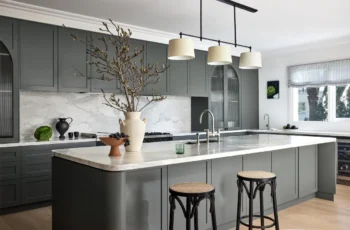
Marble Benchtop

Why should you go for a Marble Benchtop?

Why should you go for a Marble Benchtop? Marble is regarded as a great surface for bathrooms, workplaces, fireplace surrounds, and a variety of other applications where it is not subjected to a lot of wear and tear. When asked about the benefits of installing Marble Benchtops, the common response from a contractor is always where will the marble be applied. Marble is formed from metamorphic rock. It begins as a sedimentary rock called dolomite or limestone, and after being subjected to extreme heat and pressure, it transforms into a beautiful stone. Because of impurities in the primary dolomite or limestone rock, the transformation occurs. The materials crystallize when exposed to heat and pressure. When it comes to calcium carbonate stones, the clearest you’ll find is white. In ancient times, craftsmen used this flawless stone to carve statues. There are numerous reasons why you should use it as a benchtop. Our Marble Slabs Range Helicanus Marble Golden Spider Marble Diano Reale Marble Breccia Anatolia Marble View All Our Stone Slabs Range Silver Patagonia Quartzite Sierra Wave Granite Patagonia Retro Granite Iceborne Quartzite View All Benefits of Marble Benchtops: Magnificent Beauty When it comes to benchtops, the main reason why marble benchtops remain in high demand is because of their exquisite appearance. Marble’s distinctiveness is a significant and evident value. Marble is a unique natural stone that can’t be duplicated. This volcanic stone comes in a beautiful array of colors. Solid white, solid black, and a wide range of colors, including rose, yellow, grey, green, white marble, and black, are among the options. Because marble is a natural product, individual slabs may contain faults that are difficult to see in photographs; therefore, when selecting natural marble for your benchtops, you must select the slab personally. Because the color and pattern may appear differently in person, it’s critical that you select the ideal slab for your kitchen. Heat resistant Marble can withstand high temperatures. In the kitchen, a hot pan will not injure it unless it is left hot for an extended period. It has also become very popular for fireplace surrounds since it is heat resistant and can even withstand periodic sparks on its surface. More ability to design If you need a benchtop that requires more than standard manufacturing, marble is a good option. A rectangular benchtop isn’t found everywhere. It is softer to work with than many other common stone slabs used for benchtops. As a result, general workability has greatly improved. It’s also worth considering whether you want fancy edges or other construction features. Marble is a dream to work with when compared to granite. Granite is a particularly difficult stone to cut without chipping or causing harm. Naturally cold Working on marble benchtops is a dream come true for anyone who bakes frequently. It is inherently chilly and does not carry heat. Durability Although it is a delicate stone, it is extremely long-lasting. One disadvantage of using marble for benchtops is that it is susceptible to scratches and marking. Marble tends to chip and scratch because it is a softer stone, however, this can be perceived as distinctiveness. It is also a porous material. Although marble will not look brand new indefinitely, certain general care guidelines can assist to slow down the aging process. A sealer will prevent permanent stains and allow you to wipe up any spills without damaging the surface. Because the absorption rate is the same on all three surfaces, polished, honed, and leather finishes will all be similarly protected. Broadly Available Finding the right granite or quartz slab for your kitchen can be difficult at times. Marble, on the other hand, is widely available and can be easily found at most stone yards or fabricators. In most circumstances, this means less time waiting for the right stone to arrive. Find the Perfect Stone for Your Project Not sure which stone will suit your kitchen, bathroom, or outdoor space? Explore our curated selection of natural stone slabs and get expert advice on the best choice for your design. View our Range Related Posts

CONTINUE READING ➞
Calacatta Marble

Why is Calacatta Marble the most popular?

Why is Calacatta Marble the most popular? Italian marble such as Calacatta is unrivaled in the natural stone world when it comes to purity and beauty. Renowned for its bold veining and intricate patterns, it should come as no surprise that this stone was utilized in some of history’s most notable structures, primarily castles and cathedrals. The timelessness and elegance of this stone speak with its bright white color and detailed veining. This marble was favored by the famous Italian sculptor Michelangelo. Associated with luxury, elegance, and refinement, Calacatta Marble is used as a status symbol in both residential and commercial structures all over the world. Our Calacatta marble Slabs for Countertops Calacatta Viola Marble Calacatta Verde Marble Calacatta Vagli Marble Calacatta Statuario Marble View All Our Stone Slabs Range for Countertops Silver Patagonia Quartzite Sierra Wave Granite Patagonia Retro Granite Iceborne Quartzite View All Where is Calacatta Marble quarried from? Calacatta marble is sourced from quarries in the Apuan Mountains in Carrara, Italy. This marble originates from a wide mountain range in the Carrara region. This mountain range quarries other marbles as well such as Carrara, Statuario, and more. Every one of these stones is a white marble with a geological formation that is akin in nature. The production of Calacatta Marble Slabs is limited and tightly controlled. Quarrying becomes extremely difficult in the high winter months on Carrara’s mountain top, therefore seasonal conditions have an impact on production. Some quarries produce Calacatta marble that is superior to others. The Borghini Quarry, for example, is one of the oldest and seasoned quarries in the Carrara region, with some of its cuts dating back to Roman times. Quarried from the undisputed marble capital of the world, this stone is often compared with Carrara Marble.  Despite the resemblance and similarities, the subtle difference speaks volumes. Carrara Marble sports a silver-grey background with soft veining, whereas Calacatta Marble flaunts white background with bold veining. Why is Calacatta Marble super costly? Calacatta Marble is unique in look and it can only be found in one region in the world, near Carrara, Italy. Hundreds of years ago, the Italians found that what distinguishes all of the white marble in the Calacatta Region is the stone’s veining and how white the background is. The more expensive the slabs are, the whiter the material is. The more ‘uniform’ the veining in a stone is, the more expensive it becomes. The seasonal factors and the color of the stone contribute to the natural stone’s rarity and high price. Is Calacatta Marble durable? Marble is a hard natural stone that’s been formed under extreme heat and pressure on the Earth. It is a durable and heat-resistant substance. A marble countertop that is sealed and cleaned regularly is a stunning and long-lasting choice for kitchens and bathrooms. Things to be aware of with marble benchtops are that they require some care and maintenance to keep them looking fantastic. Cutting boards should be used to safeguard marble worktops, and they should be wiped clean after each usage, sealing the stone is also a must. Where can the Calacatta Marble be used? This natural stone is favored as a decorative stone in interior and exterior designing. Used in bathrooms, marble countertops in the kitchen, feature walls, fireplaces, marble flooring in offices, as tiles in an indoor application, and more. If you’re aiming to convey a sense of refinement and elegance to a space,  Calacatta Marble will not let you down. What backsplash goes with Calacatta Marble? Backsplashes add texture and detail to a kitchen. Not overpowering, but pleasing to the eye, textured backsplashes with intricate designs add tones of different colors. With a Calacatta Marble benchtop, a balance of colors is essential. The aesthetics of your kitchen need to be well thought out for symmetry and elegance. With white cabinetry and white calacatta marble benchtops, white backsplashes take after a serene atmosphere, provided the other articles and pieces of furniture are black or brown. With some brown or wood cabinetry and an off-white calacatta marble benchtop, backsplashes with intricate designs in blue, green, and orange would brighten up your kitchen. Calacatta Marble Benchtop Remember that while  Calacatta Marble looks fantastic on any surface or in any area, it does require some upkeep when used as a benchtop. Because of the deep richness of the white, most stains that form on this porous material will be quite visible if not attended to. Regularly sealing with a sealant, using a non-acidic cleaner to avoid etching, and cleaning food spills immediately to avoid staining are some points to keep in mind. Offering an elegant look with its fewer but vivid and unstructured veining, with  Calacatta Marble  you can design a limitless number of looks and styles for your benchtop. Here at Avant Stone, we have seven different types of  Calacatta Marble  to turn your kitchen around. Here are some color recommendations: With white cabinetry, our Calacatta Bella or  Calacatta Statuario  will suit very well as it will add to the sophistication of the space. Due to hues of grey flowing through the stone, it will provide a sort of calm in the atmosphere. With soft brown or soft peach cabinetry, our Calacatta Oro  will add some depth and warm up the area. With dark brown and gold cabinetry, our  Calacatta Vagli  with its warm white background and soft gold veining will provide charm and delightfulness. With pastel cabinetry, our Calacatta Corchia, and  Calacatta Viola  would balance the colors in the room with their striking and dramatic appeal. Related Posts

CONTINUE READING ➞

Is Dolomite Suitable for Your Benchtop?

With grey, white and off-white countertops becoming increasingly trendy, there has never been a better time to discuss Dolomite Benchtops. Dolomite is another stone that closely resembles marble. Dolomite resembles marble in appearance and characteristics, and it’s priced between marble and quartzite. Because of these characteristics, dolomite is becoming a more popular material for a variety of design projects. This lesser-known stone is quickly gaining popularity as a wonderful alternative to Marble for those seeking a more durable and affordable solution. Is it, however, a good choice for your kitchen? What is Dolomite, and where is it found? Dolomite is classified as a sedimentary stone because it is formed on the Earth’s surface. It is formed when limestone and lime mud come into contact with magnesium-rich groundwater. In terms of composition and colour scheme, the rock is extremely similar to limestone. Due to the potential for misunderstanding with the mineral dolomite, which is a significant component of the stone’s composition, it is also known as Dolostone. The distinctions between dolomite and granite, the latter of which forms in magma chambers beneath the Earth’s surface, are noteworthy. Dolomite is a common stone that may be found all over the world, with the most well-known being the Dolomite Alps in Italy. Sedimentary basins, which are shallow areas of warm water rich in calcium carbonate mud, shell debris, coral fragments, and feces, are areas where sedimentary rocks can be found. Dolomite stone is comparable to limestone in composition, and the two forms of rock have similar colouration, ranging from white to grey. Their prominence in the construction business is another similarity between the two. Dolomite countertops are just high-polished slabs cut from dolomite limestone, and they look fantastic. They’re so ubiquitous that they’re offered as marble or quartzite. Nonetheless, this misunderstanding must be resolved, as Dolomite is neither as hard nor as delicate as quartzite or marble. Uses of Dolomite One of the most common uses for dolomite stone is to create countertops for kitchens, bathrooms, and offices. Dolomite Stone Benchtops are long-lasting and offer a lovely appearance. Dolomite stone slabs can have rich and appealing veins of fossilised minerals running through them, giving each piece of stone a distinct appearance. When prepared, dolomite also offers a firm, smooth, and shiny surface that is easy to maintain. Due to their properties, Dolomite Benchtops are perfect for kitchens and bathrooms. Dolomite is used for interior flooring and interior tops, such as kitchen countertops, feature walls, surrounds for the tub, pavers for the outside, cladding for the outside, statues, and monuments. How to clean a Dolomite Benchtop? Dolomite, like other natural stones, should be cleaned with either stone cleaners or mild soap. A wet sponge is generally sufficient to remove the grime. It is recommended to use coasters and chopping boards to avoid stains from oils or red wine. Make sure to wipe spills off right iaway Some benefits of Dolomite are as follows: The appearance of the stone Dolomite Countertops are more commonly available in grey and white, and they frequently have streaks that make them look more like marble than quartzite, which is why they’re so trendy right now. Despite their rarity, you can locate them in a variety of colours, including brown, pink, black, and green. Its appearance lends itself easily to the creation of elegant interior designs, making it ideal for use as countertop and backsplash materials. Stain Resistance Dolomite has a lower liquid absorption rate and is less acid-sensitive than Marble. Nevertheless, it will need to be sealed regularly, most likely annually. Acids should be avoided. If dolomite is exposed to them, it will etch. Dolomite is a safer option in comparison to marble, but you will still need to provide care and exercise vigilance at all times. Heat Resistance Perhaps Dolomite’s greatest advantage over Quartz countertops; the engineered stone is also available in attractive white and grey tints, and it is more heat, scratch, and stain-resistant than quartz. Quartz, on the other hand, cannot withstand heat or sunshine, and a hot pan will permanently mark it. Dolomite can, and it can hold a lot of heat. Cost-Effective This is an area where dolomite will make headway because most of its variations are less expensive than marble, quartz, and even granite. However, you should always get a quote from a local stone source to be sure. Durability A dolomite countertop is expected to outperform marble and last even longer. Considering that we’re talking about Dolomite, with proper care, the stone can live for decades and stay gorgeous. The stone is extremely durable, and while it is more prone to cracking and chipping than granite, it is unlikely to occur. Scratch Resistance Dolomite is commonly described as being between marble and granite in terms of hardness, and while this is correct, it can often be misleading. Dolomite is a fantastic alternative to Marble, and it is far more scratch-resistant than that stone. However, don’t expect it to be as scratch-resistant as granite or quartzite; you’ll have to be cautious with your everyday usage. Glass and metal will harm the dolomite worktop; therefore, cutting boards should always be used, and silverware should be handled with utmost caution.

CONTINUE READING ➞
Wishlist
Recently Viewed
Categories