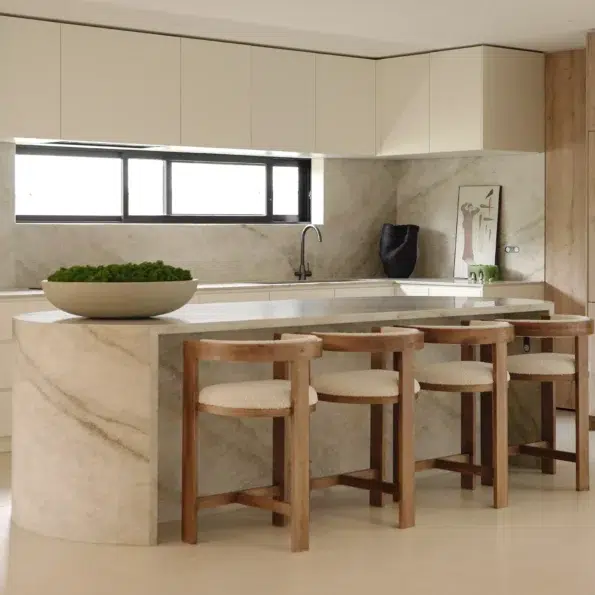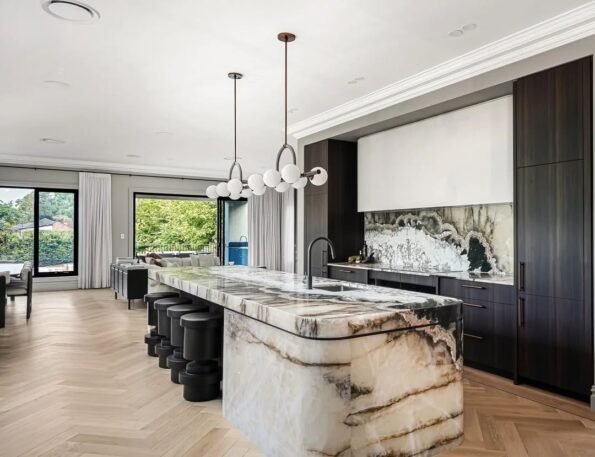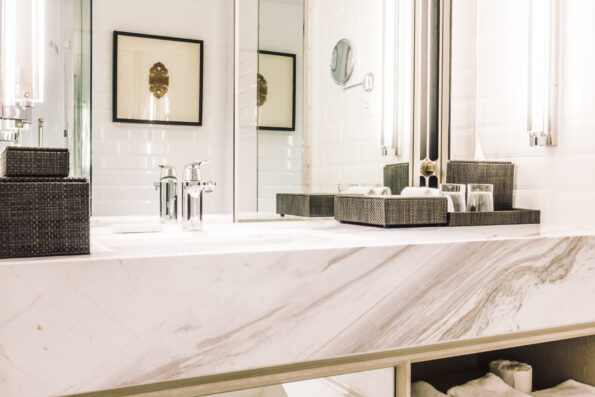


A porcelain slab splashback gives a kitchen one clean, continuous surface with no grout lines to scrub. It handles heat and steam well and comes in everything from soft marble looks to solid colours. The harder part is working out what it will cost, because two kitchens of similar size can receive very different quotes.
As a natural stone and porcelain slab supplier with galleries in Sydney and Newcastle, we talk through splashback budgets with homeowners, designers and fabricators every week. The cost moves with the slab, the wall and the job, so this guide explains what sits behind a quote and where you have room to save.
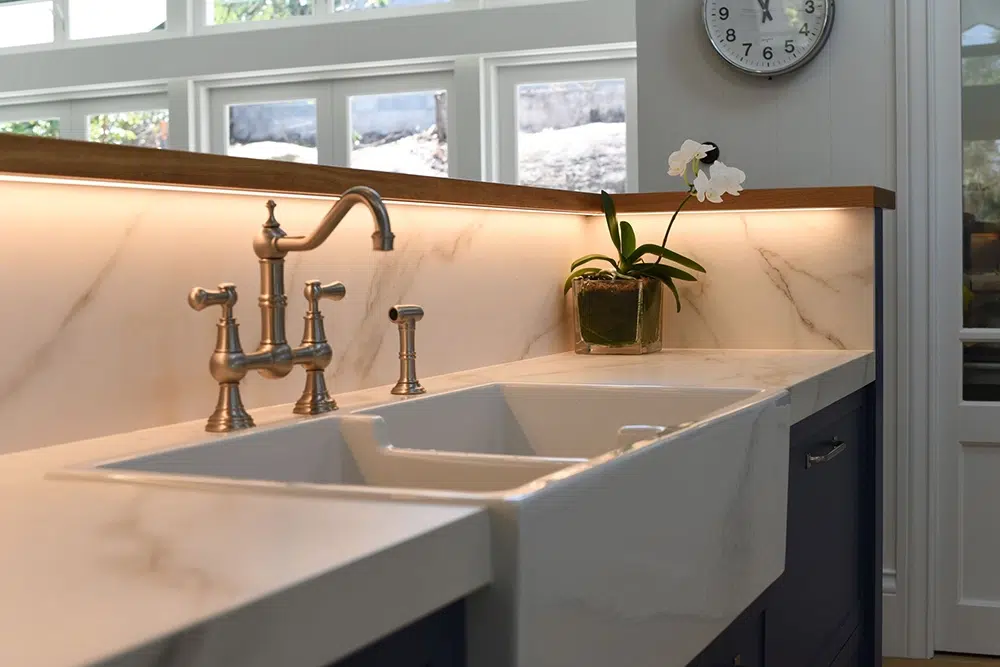
Why there isn’t one price per square metre
Tiles are sold by the square metre, so the maths is simple. Porcelain slabs are different. They are sold as whole slabs, commonly around 3200 × 1600 mm, and then cut to suit your wall. The total is made up of three parts: the slab itself, the fabrication (cutting, cut-outs and edge finishing) and the installation.
That is why a slab splashback usually costs more than a basic tiled one. The material comes in large pieces and needs specialist cutting and handling, and no two walls ask for the same amount of work. Where your project lands depends on the seven factors below.
What affects the cost of a porcelain splashback
1. The slab you choose
Design and finish are the biggest variables in the material cost. Plain colours and simple patterns are generally the most affordable. Slabs with realistic marble veining, bookmatched patterns or special finishes such as honed, matte or textured surfaces cost more to produce and are priced accordingly. If you’re still weighing up the material itself, it helps to understand the pros and cons of porcelain slabs in a kitchen before you compare designs.
2. Slab thickness
Porcelain slabs typically come in thin panels of about 6 mm and thicker formats of 12 mm and 20 mm. Thin panels are the usual choice for splashbacks. They are lighter, easier to fix to a wall and use less material, which keeps the price down. Thicker slabs cost more and are normally chosen when the splashback is cut from the same slab as the benchtop, or when a design calls for a deeper exposed edge.
3. How many slabs your wall needs
You pay for whole slabs, not just the area you use. A standard splashback run of around 600 mm high can often come out of one slab, while a full-height splashback to the ceiling, a long galley wall or an L-shaped kitchen may need two or more. Layout matters too. If the pattern has to run in one direction, or the veins need to line up across a join, your fabricator has less freedom to nest the pieces, and more of the slab ends up as offcut.
4. Cut-outs and detailed cutting
Porcelain is extremely hard, which is why it wears so well, but it also means every cut needs diamond tooling and care. Each power point, switch, rangehood duct or window return adds fabrication time. Internal corners are the riskiest cuts, because a slab can crack there if it’s rushed. A wall with one power point is a very different job from one with five, so count them before you ask for a quote.
5. Joins, vein matching and edges
A splashback that needs a join costs more than one cut from a single piece, particularly when the pattern has to flow across it. Exposed edges need finishing as well. A simple polished edge is the most economical. Mitred edges, where two pieces meet at 45 degrees around a window reveal or shelf, look seamless but take more time. Deciding how the splashback will meet the benchtop early on makes these choices easier, and planning the two surfaces together is the best way to pair your benchtop and splashback without paying for changes later.
6. The condition of the wall
Porcelain panels need a flat, sound surface. A new kitchen with fresh wall sheeting is straightforward. A renovation can add cost if old tiles or glass have to be removed, plaster needs repair or the wall is out of plumb. This work is often quoted separately by your builder or installer, so check whether it’s included.
7. Access, delivery and installation
Large slabs are heavy and awkward to move. Installation usually needs at least two people and the right lifting equipment. Stairs, apartment lifts, tight hallways and long carries from the street all add time. Your location affects delivery charges, and installers price differently across Sydney, Newcastle and regional areas.
Slab or tiles: how the costs compare
Tiles usually win on upfront price. A slab costs more at the start but gives a seamless finish with no grout to stain behind the cooktop, which is the reason most people choose it.
Material: Porcelain slabs are sold as whole slabs, while porcelain tiles are sold by the square metre.
Fabrication: A slab needs specialist cutting and cut-outs in a workshop. Tiles are cut on site by the tiler.
Grout lines: A slab splashback has none, or a single join. A tiled splashback has grout lines throughout.
Cleaning: A slab wipes clean. Grout needs regular attention to stay fresh.
Ways to keep the cost down
Order the splashback with the benchtop: If both come from the same slabs, your fabricator can plan the cuts together and reduce waste.
Choose a thin panel: A 6 mm slab is usually all a splashback needs.
Keep to a standard height: Running to the underside of the overhead cabinets uses far less material than going to the ceiling.
Reduce the cut-outs: Moving power points under the overhead cabinets or onto an island cuts fabrication time and gives a cleaner look.
Pick from slabs in stock: Designs that are already in the warehouse avoid special-order delays and freight.
Measure after the benchtop is in: Final measurements taken at that stage prevent expensive recuts.
How to get an accurate quote
A quote is only as good as the information behind it. Before you ask for one, measure the length and height of each wall, count the power points and switches, and note any windows, shelves or rangehood ducts the splashback has to work around. Photos of the wall and a copy of your kitchen plan help a great deal.
It also pays to see the slab in person. Photos rarely show how a pattern reads across a full sheet, and viewing it lets you and your fabricator decide where the cuts and joins will fall. You can view our full range of porcelain splashbacks at our Sydney gallery in Greenacre or our Newcastle gallery in Beresfield, and our team can help you work out how many slabs your kitchen needs.
Call 02 9817 0037 (Sydney) or 02 8321 0742 (Newcastle) to book a visit.
FAQs
5 quick answersUsually, yes. Tiles cost less to buy and can be cut on site, while a slab needs specialist fabrication and handling. The trade-off is a seamless surface with no grout lines to clean.
It depends on the stone. Porcelain is often more affordable than premium marbles and quartzites, but prices overlap, and the fabrication costs are similar. Compare specific slabs side by side, not materials in general.
Yes, and it’s a popular choice. Using the same material gives a continuous look, and cutting both from the same slabs can reduce waste. Your fabricator will advise whether the thickness suits both uses.
Thin panels of about 6 mm suit most splashbacks. Thicker 12 mm slabs are normally used when the splashback matches a 12 mm benchtop.
Porcelain is non-combustible and copes very well with heat, which is why it’s so common behind cooktops. Your installer will still follow the clearances set out by the cooktop manufacturer and Australian gas installation standards.