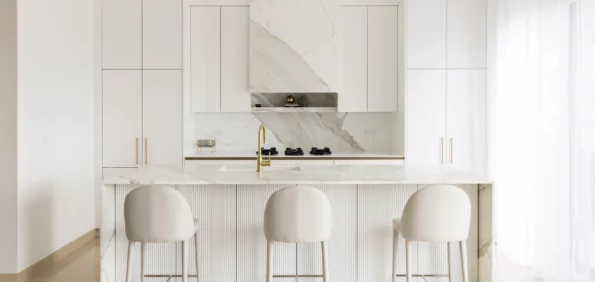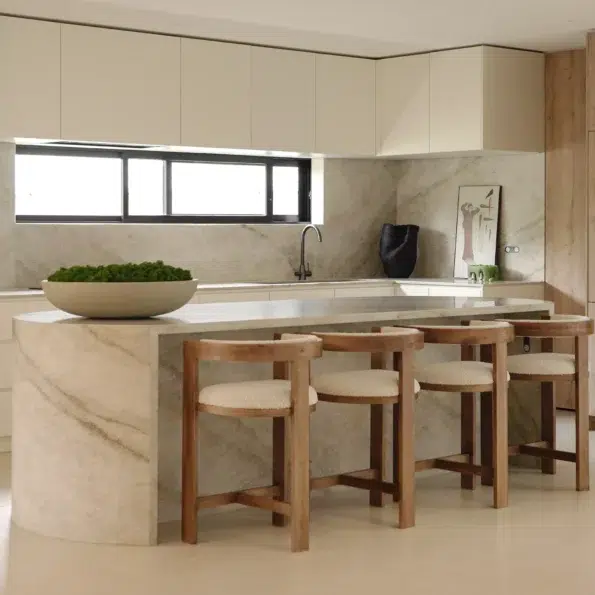


Porcelain benchtops have become a popular choice in Australian kitchens. They resist stains and heat, never need sealing and come in designs that range from soft marble looks to concrete and solid colours. They are also a different material from stone, and most problems with porcelain come from treating it like granite or marble at the selection and fabrication stage.
As a natural stone and porcelain slab supplier, we often see the same few mistakes. Each one is easy to avoid if you know about it before you order.

1. Choosing from a small sample
A sample tile shows you the colour and finish. It cannot show how the pattern moves across a slab that is more than three metres long, where the strongest veins sit or how the design repeats.
Most porcelain designs are printed, and many collections are produced with several different faces, so two slabs of the same design can look noticeably different. View full slabs before you commit, and if your kitchen needs more than one, ask how the faces will match across joins and on the island.
2. Not checking whether the pattern runs through the slab
This can be a major source of disappointment. In many porcelain slabs, the design is printed on the surface and the body underneath is a plain colour. That is fine on the face, but it shows wherever the slab is cut: on exposed edges, around an undermount sink and anywhere a chip occurs.
A colour-matched body makes exposed edges and small chips less noticeable. A colour-matched or full-body slab does not necessarily have veining that continues through its thickness, though. Some products offer through-body veining, while others have a more uniform body beneath the printed surface. Ask to see a cut edge of the exact product, particularly if you are planning an undermount sink or exposed edges.
3. Picking the wrong thickness
Porcelain comes in several thicknesses, and each suits different uses:
6 mm: Generally used for wall cladding, splashbacks and furniture. Whether it can be used on a benchtop depends on the manufacturer’s approved installation system.
12 mm: A common choice for kitchen and bathroom benchtops. It is strong when properly supported and gives a slim, modern edge.
20 mm: A thicker slab that gives a more substantial edge profile.
Thickness is only part of the picture. The right choice depends on the exact product, the support system, the cut-outs and any overhangs, so check the manufacturer’s benchtop specifications before you decide, including for outdoor kitchens.
4. Choosing an edge that doesn’t suit porcelain
Stone can be shaped into rounded and bullnose edge profiles because its colour runs right through. Porcelain is different. Shaping a printed slab exposes the plain body, and very thin edges are more likely to chip.
Most porcelain benchtops use a square-looking edge with a small manufacturer-specified bevel or radius, or a mitred edge, where a strip of the same slab is joined at 45 degrees so the benchtop looks much thicker than it is. Mitred edges look excellent with porcelain, but the joint needs precise cutting and an experienced fabricator, because a thin 45-degree tip is the most fragile part of the edge.
5. Using a fabricator without porcelain experience
Porcelain is extremely hard and dense, and it behaves differently from stone during cutting. It needs the right diamond tooling, manufacturer-specified cutting speeds, careful support of the slab and rounded internal corners on cut-outs. A fabricator who cuts it like granite is far more likely to chip edges or crack the slab around the sink and cooktop.
Ask your fabricator how much porcelain they work with, and ask to see finished porcelain jobs, especially mitred edges and undermount sinks.
6. Ignoring overhang and cut-out support
Porcelain is strong, but a 12 mm slab has less stiffness than 20 or 30 mm stone. Island overhangs for seating, breakfast bars and the narrow strips in front of and behind a sink or cooktop all need proper support.
Overhang limits vary between manufacturers and depend on the slab’s thickness and backing, so your fabricator should work from the manufacturer’s installation guide for the exact product. Large sinks also need support underneath, rather than hanging only from the benchtop. Planning the brackets and supports before templating avoids changes later.
7. Overlooking the finish
The finish changes how a porcelain benchtop looks and lives. Polished porcelain is glossy and makes colours look richer, but it shows fingerprints, smears and reflections more readily. Matte and honed finishes look softer and hide fingerprints, although some can pick up grey marks from metal pots and utensils, which usually clean off with the right cleaner.
Ask to see the finish you are considering in person, and wipe it, touch it and look at it under different light before you choose.
8. Assuming porcelain is indestructible
Porcelain handles everyday kitchen life very well. It does not need sealing, it resists stains from wine, coffee and oil, and it copes with heat better than many surfaces. It is still worth treating with a little care. Edges and corners can chip if they are hit hard by a heavy pot. Porcelain can handle the heat of everyday cooking, but using a trivet and following the product’s care guide is still a good habit.
Cutting directly on the surface is also best avoided. Porcelain is harder than most knife steel, so it is usually your knives that suffer.
9. Confusing porcelain with other materials
Porcelain, sintered stone and engineered stone are often mentioned together, but they are different products. Porcelain and sintered stone are made by firing natural minerals at very high temperatures, without the resins used in engineered stone. Australia’s ban on the manufacture, supply, processing and installation of engineered stone benchtops, panels and slabs took effect on 1 July 2024. Porcelain and sintered stone products that do not contain resin are excluded from the ban, so it is worth being clear about which material you are being quoted for.
Understanding the trade-offs before you choose makes the decision easier, and the pros and cons of porcelain slabs in a kitchen are worth weighing against natural stone alongside your design.
Choosing porcelain with confidence
The best porcelain benchtops come from three things: seeing the full slab, choosing the right thickness, edge and finish for how you use your kitchen, and working with a fabricator who knows the material. Get those right and porcelain will give you a tough, low-maintenance surface for many years.
You can see our range of porcelain kitchen benchtops in full-size slabs at our Greenacre showroom in Sydney and our Beresfield showroom in Newcastle. Call 02 9817 0037 (Sydney) or 02 8321 0742 (Newcastle) to book a visit.
FAQs
5 quick answersThe flat surface is very hard and resists scratching. The edges and corners are the most vulnerable areas, especially thin or mitred edges. A suitable edge profile and an experienced fabricator who follows the manufacturer’s guidelines reduce the risk.
A 12 mm slab is a common choice for porcelain kitchen benchtops, while 20 mm provides a thicker profile. The right thickness depends on the product, support system, cut-outs and overhangs. Check the manufacturer’s benchtop specifications before choosing.
Yes. A mitred edge joins a strip of the same slab at 45 degrees, so a 12 mm or 20 mm benchtop can look 40 mm thick or more. It needs precise fabrication to avoid chipping at the joint.
No. Porcelain is non-porous, so it does not need sealing. Regular cleaning with a soft cloth and a pH-neutral cleaner keeps it looking its best.
Porcelain and sintered stone are closely related mineral-based surfaces, and the terminology can overlap. Their composition, manufacturing processes and performance vary between products, so compare the technical specifications and installation requirements of the exact slabs you are considering.